
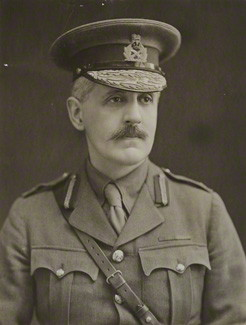
Major-General Sir Fabian Arthur Goulstone Ware KCVO KBE CB CMG
18th November 2022
On the 18th November, members were treated to a fascinating presentation from David Du Croz. David was Head of History at Marlborough College for eleven years. Whilst researching the lives of past pupils involved in the great war, he was drawn to the war cemeteries of Flanders and the surrounding areas, and how they came about and were built.
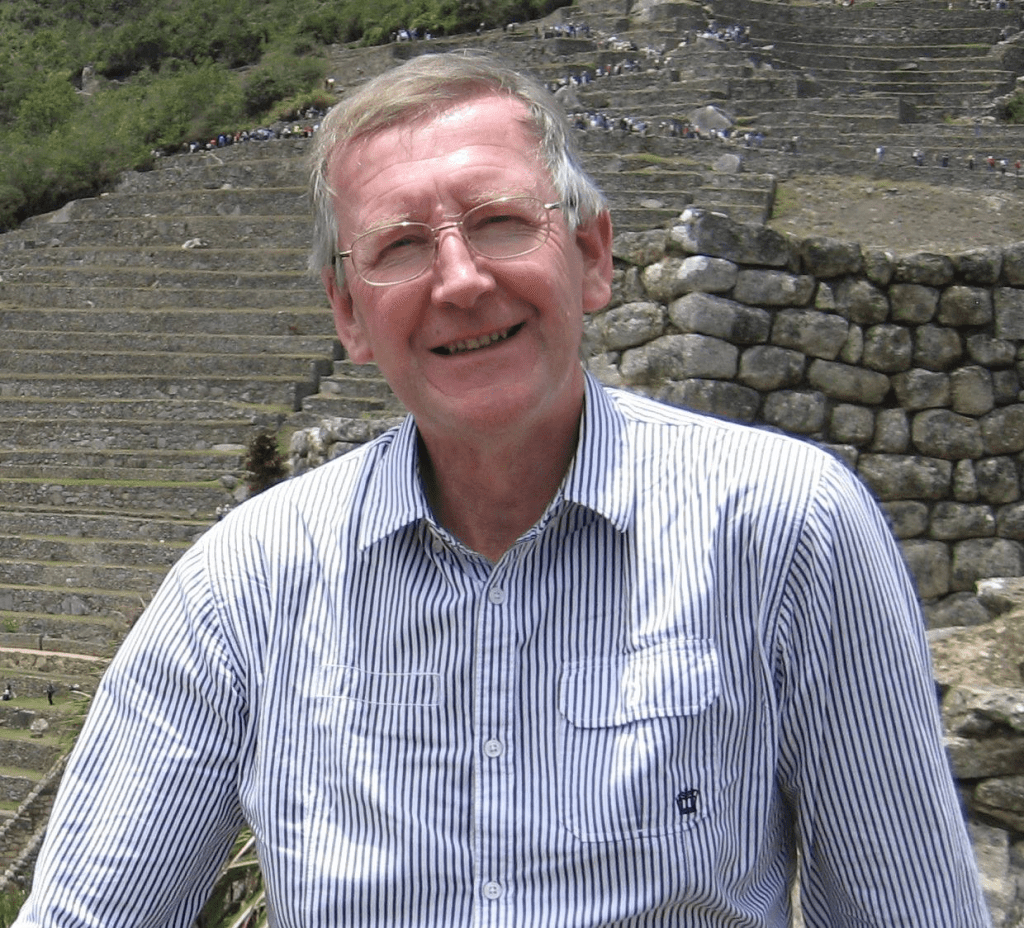
David du Croz
This in turn led David to the life and work of Fabian Ware, who was undoubtedly the driving force behind the concept and creation of the war cemeteries as we see them today.
In a very informative talk, David described how working with a mobile ambulance unit became the catalyst for recording the dates and locations of fallen servicemen.
Wikipedia describes Fabian Ware as follows:
Major-General Sir Fabian Arthur Goulstone Ware KCVO KBE CB CMG (17 June 1869 – 28 April 1949) was a British educator, journalist, and the founder of the Imperial War Graves Commission (IWGC), now the Commonwealth War Graves Commission (CWGC). He also served as Director of Education for the Transvaal Colony and editor of The Morning Post.
Born in Clifton, Bristol, he graduated from the University of Paris in 1894. After working in various education capacities, he travelled to the Transvaal Colony where, as a member of Milner’s Kindergarten, he became Director of Education in 1903. Two years later, Ware became editor of The Morning Post and returned to England. While editor, he expanded the paper and reoriented it to focus on colonial affairs. After several controversies, culminating in a failed effort to purchase an airship for the United Kingdom, Ware was forced to retire in 1911.
When the First World War started in August 1914, Ware attempted to join the British Army but was rejected because he was too old. With the assistance of Alfred Milner, he obtained an appointment as the commander of a mobile ambulance unit provided by the British Red Cross Society. In this role he began marking and recording the graves of those killed. The unit soon began to focus exclusively on graves, and the organisation was transferred to the British Army in 1915. The following year the Army Department of Graves Registration and Enquiries was created with Ware at its head. On 21 May 1917 the Imperial War Graves Commission was founded. Ware served as vice-chairman. He ended the war as a major-general, having been mentioned in despatches twice.
Post-war, Ware was heavily involved in the IWGC’s function. He frequently led negotiations with foreign nations over cemeteries and memorials, dealt with prominent figures in the commission, and worked to ensure the commission’s financial security. Ware also attempted to raise support for his ideal of cooperation between the Dominions. In the lead-up to the Second World War, he attempted to use the IWGC’s work as a tool for ensuring peace. When war broke out, he continued to serve as vice-chairman of the IWGC and was re-appointed director-general of Graves Registration and Enquiries. He retired from the Commission in 1948 and died the following year.
David’s talk included additional interesting details on the design, construction, and upkeep of the cemeteries, including the work of Edward Lutchens and Gertrude Jekyll.
Although David admitted that his subject would not be ‘a laugh a minute’ it was delivered in way that engaged the members and shone a spotlight on someone I suspect most had never heard of. Those who had lost family or loved ones to the folly of war certainly owe Fabian Ware a debt of gratitude for striving to record the fallen and remember their sacrifice in perpetuity.
David was given a very warm vote of thanks.
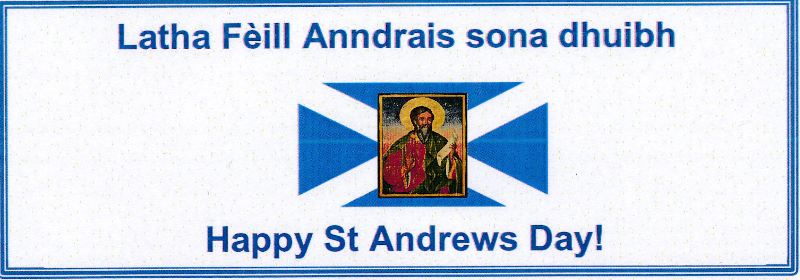
‘Happy St Andrews Day!’ in Scottish Gaelic.
There followed a formal dinner to celebrate St. Andrews Day, complete with Scottish themed menu including Cullen Skink. This was followed by a toast to the King, and the Club, with whiskey of course. An appreciation of St. Andrew and the saltire was delivered by Brian Sharpe in his usual eloquent and humorous fashion.
All agreed it had been a most enjoyable event.
Discover more from Probus Club of Salisbury
Subscribe to get the latest posts sent to your email.
 Probus Club of Salisbury